
Austin County Sex Offender Checks
The Texas Public Sex Offender Registry is the main public channel for Austin County. Texas DPS compiles information submitted by local law enforcement under Code of Criminal Procedure Chapter 62. Searchers can use a name when they know whom they seek, or use location fields to learn what the registry reports near a home, school, or other point of concern. A county filter helps keep Austin County separate from the City of Austin, which is in Travis County.
Local authority depends on where the person lives. A municipal police department generally registers someone who lives inside its city. The Austin County Sheriff is the registering authority outside a municipality, subject to any centralized local arrangement. Because city limits and mailing addresses do not always match, a result tied to Bellville, Sealy, or Wallis may come from a different local office than the mailing city suggests. DPS is the public statewide view, while the relevant police department or sheriff handles local reporting and suspected failures to comply.
Austin County Name and Radius Searches
Start with the route that best matches what is known. A name search is useful when the spelling and identity are fairly clear. An address search is better for community awareness around a specific place. County, city, and ZIP fields can narrow a large result set, while a radius can catch nearby records across a city boundary. Try both the county and address routes when a rural Austin County location produces no match.
The registry screen shown in the official DPS search source is the right starting point for those field choices.
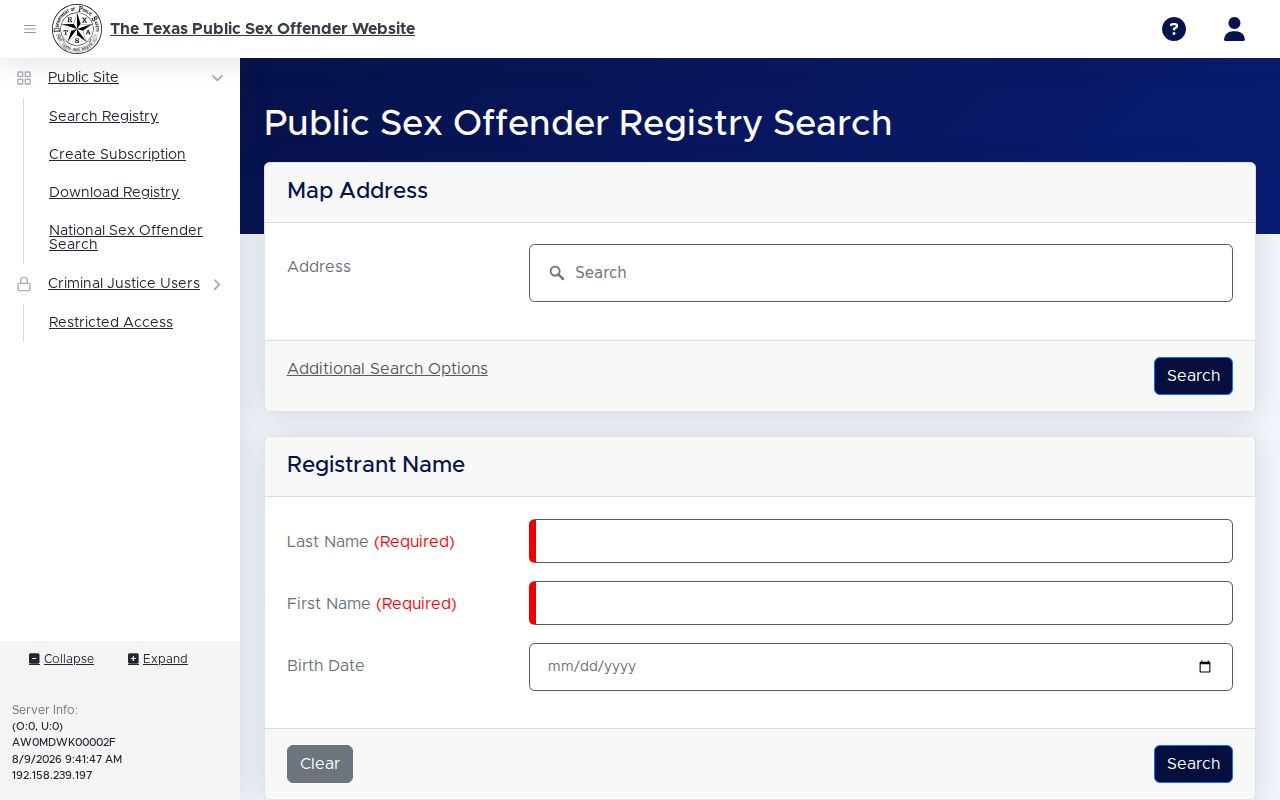
The interface matters because a blank result from one route does not settle the question. Recent moves, aliases, rural address formats, and location boundaries can affect what a single query returns.
Texas Public Sex Offender Registry Searches
DPS offers several ways to shape a Texas Public Sex Offender Registry search. No one field is required in every route. Name searches depend on a surname, while place searches can begin with an address and radius. Use more detail only when it helps distinguish matches. The separate institution-of-higher-education route should be used only when that is the location being checked.
- Open the DPS registry and review its conditions of use.
- Choose a name, address, or other location-based search route.
- Add Austin County, a city, ZIP code, or radius to narrow the results.
- Open a likely profile and compare identifiers, status, offense, and registering authority.
| Field | Type | Required | How it helps |
|---|---|---|---|
| Last name | Text | Route-dependent | Starts a name search |
| First or middle name | Text | No | Narrows similar names |
| Address | Text | Address route | Sets a location point |
| City, county, or ZIP | Text or selection | No | Limits the geographic area |
| Radius | Selection | Address route | Expands around an entered address |
| Higher education | Search route | No | Supports a campus-related query where offered |
Austin County and Cross-State Movement
The Texas registry is the best state source, but it is not the only useful layer. The U.S. Department of Justice operates the National Sex Offender Public Website, or NSOPW, to search participating jurisdictions across state lines. That broader search can help when a person has recently moved, an alias points to another state, or the location history is uncertain.
The national search pictured from the official NSOPW source complements, but does not replace, the Austin County and Texas search.
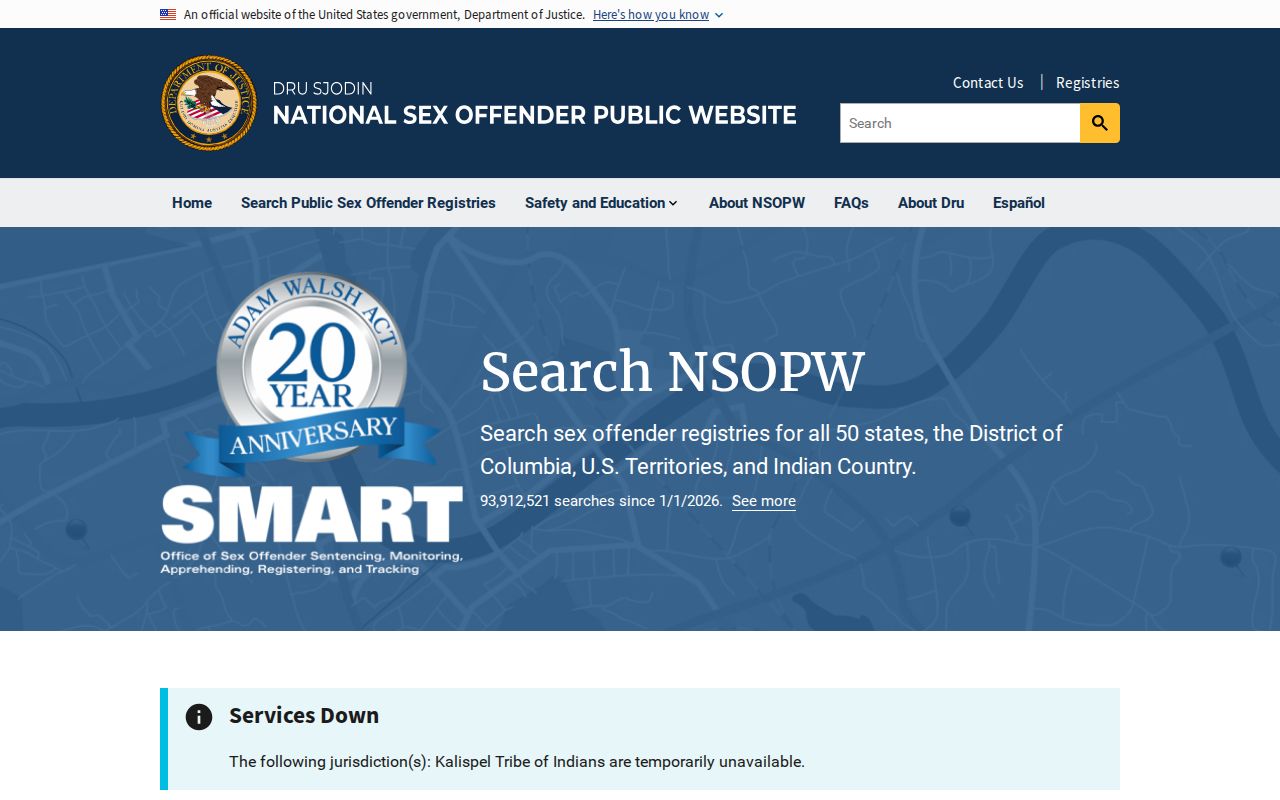
Compare any national match with the Texas profile and its local registering-authority field. Each jurisdiction controls the record it contributes, so source details and update paths may differ.
Use the two systems as a sequence. First search Texas by the strongest known name and place details. Then repeat the name through NSOPW if travel, a former residence, or an out-of-state alias is relevant. Return to the contributing jurisdiction shown on a national result for the full source record. That check is more sound than treating a missing Austin County pin as proof that no public record exists elsewhere.
Registry Profiles: What They Show
A public profile provides identifiers and registration facts meant to help a reader distinguish one person from another. Match several fields, not just a common name or a photograph. The offense information describes a conviction or adjudication that led to a reportable duty. It does not predict future conduct, and the address reflects reported registry data rather than a promise that the person is present at that spot.
| Name and aliases | Published names that help connect variant identities. |
|---|---|
| Photo and description | Current photo when available, sex, race, age or birth data, height, weight, hair, eyes, and identifying marks. |
| Address or location | Registered residence or a location description reported to the authority. |
| Offense details | Offense name, statute, conviction or adjudication date, punishment, and victim-age category. |
| Risk level | Texas numeric assessment of relative risk, distinct from registration duration. |
| Status and authority | Registration or verification status and the local office responsible for registration. |
| Other public fields | Vehicle data where collected and permitted by law. |
Austin County Profiles Protect Some Data
Public access has firm limits. Chapter 62 protects Social Security numbers, driver-license numbers, phone numbers, online identifiers, employer details, confidential information added by DPS, and anything that identifies a victim. A juvenile court can also order juvenile registration kept from public view. The absence of one of these fields does not make an otherwise matching public profile incomplete.
This distinction is vital when reading offense and victim-age entries. A category can provide context without revealing the victim. Searchers should not try to infer or expose a protected identity from the offense date, address, or other public facts. The public record is deliberately narrower than the information held by DPS and the registering authority.
Vehicle details, scars, marks, and tattoos may help separate close matches when those fields are lawfully displayed. Still, no single trait should control the match. Compare the full set of public identifiers and the listed local authority before acting on the information.
Registration Levels and Duties in Texas
Texas assigns numeric risk levels through a screening tool, but those levels are not federal SORNA tiers and do not set a simple ten-year, longer-term, or lifetime schedule. Registration duration is offense-specific under Article 62.101. Many duties last for life. Other qualifying offenses continue until the later of ten years after release from a penal institution or discharge from community supervision, or through the specified juvenile period. Check the DPS reportable-conviction list and the governing offense rather than guessing from a risk number.
| Texas concept | Meaning | Duration or verification |
|---|---|---|
| Risk level 1 | Lower relative assessment under the Texas tool | Duration remains offense-based |
| Risk level 2 | Moderate relative assessment | Duration remains offense-based |
| Risk level 3 | High relative assessment that may prompt stronger notice | Duration remains offense-based |
| Annual verification | Applies to most registrants | Around the birthday, within 30 days before or after |
| 90-day verification | Applies to specified multiple sexually violent convictions or deferred orders | Once in each 90-day period |
| Lifetime or other term | Set by Article 62.101 and the reportable offense | Never inferred from risk level alone |
Austin County Registration and Verification
Registration must generally occur no later than the later of seven days after arrival or release, or the first date the local policy permits. Registrants must verify identity and residence and promptly report specified changes. The place of residence determines whether a municipal police department or the Austin County Sheriff handles the local contact. This is why a city label in a mailing address should not be treated as proof that the address lies inside that city’s limits.
The Texas Sex Offender Registration Program explains the state framework used by DPS and local authorities.
The image from the official DPS program source connects the public search with the reporting system behind it.
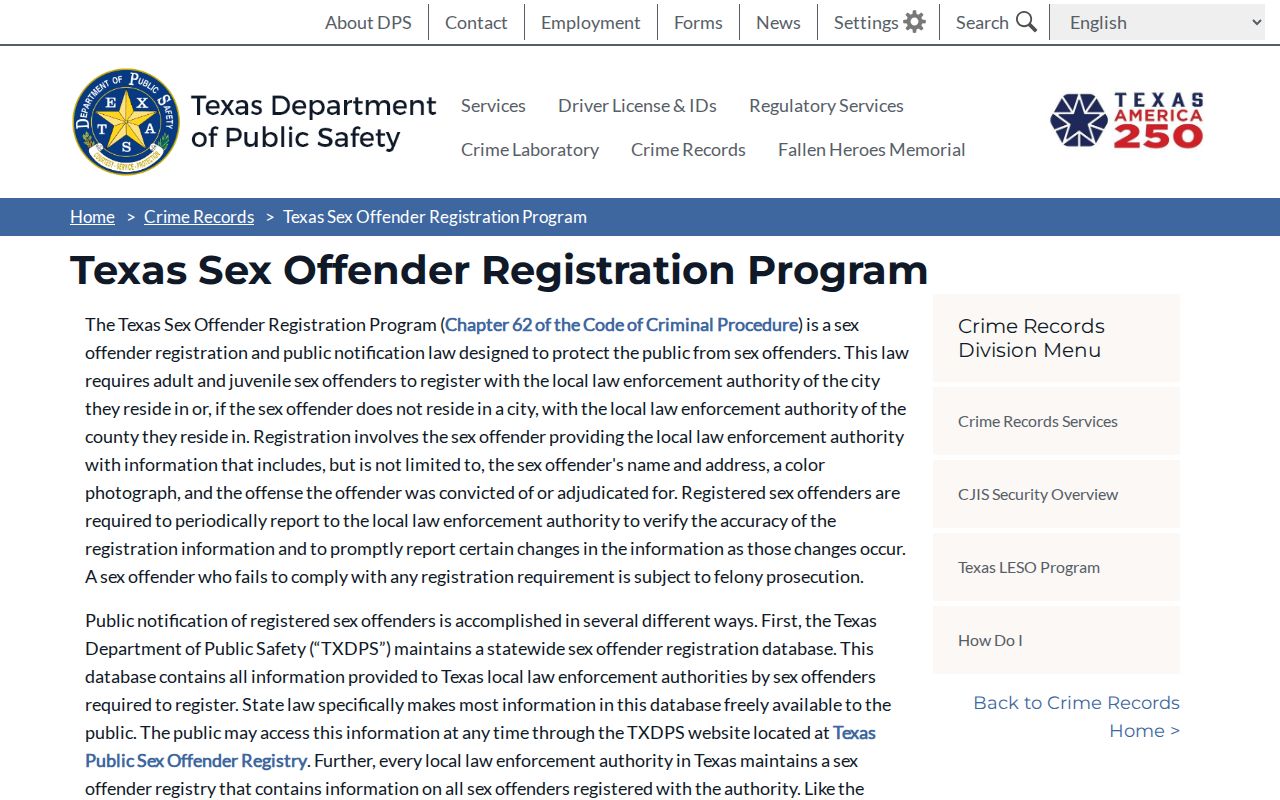
The program page is useful for understanding duties, while the public registry remains the place to run a person or location search.
Verification schedules also explain why dates matter. Most registrants verify around their birthday, within the window Texas sets. People with specified multiple sexually violent convictions or deferred orders report in each 90-day period. A visible verification date should be read with the status and duty shown, not used alone to declare a violation.
Report Austin County Registry Concerns
A suspected failure to register or update information should go to the responsible local police department, the Austin County Sheriff, or DPS Sex Offender Registration at 512-424-2800. The Sheriff’s Office is at 417 N. Chesley Street, Bellville, Texas 77418, and publishes 979-865-3112 for the office and 979-865-3111 for dispatch. Emergency threats belong with 911, not a web search or routine records call.
Describe the concern without confronting anyone. Note which official profile was reviewed, the reported address or status, and why the information appears inconsistent. Law enforcement can compare public data with nonpublic reporting records. No official Austin County sheriff registry-alert app was located, so do not rely on an unverified app that claims to supply county notices.
Using Registry Information Lawfully
The registry supports personal, family, and community safety. Texas DPS may mail community postcards when a high-risk registrant or a civilly committed sexually violent predator enters a community, and schools may receive notice required by law. Those formal notices add context to a profile, but neither a postcard nor a search result authorizes private punishment. Plan safe choices, use official reporting channels, and let law enforcement address suspected violations.
Misuse is a crime: Under Texas Code of Criminal Procedure Chapter 62 and the registry’s official warning, do not use registry information to threaten, harass, trespass, discriminate unlawfully, intimidate, or commit a crime.
A search result is not proof of a person’s current location or future acts. Recheck the official profile, use both place and name routes, and contact the listed registering authority when public-safety facts appear wrong. Responsible use protects the community while preserving the legal boundaries of this public record.