
Austin County Criminal History Checks
No single Austin County database contains every criminal record. Start with the stage of the event. The District Clerk links to local public access for felony cases in the 155th District Court. The County Clerk handles Class A and B misdemeanor filings. Municipal and justice courts retain fine-only matters. Recent custody calls belong with the jail, while the Texas Criminal History Conviction Name Search provides the statewide public slice of reported convictions and deferred adjudications.
Gather the full legal name, likely date range, and case number when available. A date of birth helps separate people with similar names, but protected identifiers may not appear in public court views. Search spelling variants and record the court, case number, status, and charge before opening documents. A blank result can mean the wrong court was searched, a filing has not arrived, or access is restricted. It does not prove that no record exists.
- Identify whether the question concerns a police report, booking, filed case, warrant, or statewide history.
- Search the correct clerk by name or case number and confirm the court and filing date.
- For present custody, call Austin County Jail and supplement the call with VINELink.
- Compare the filed charge and disposition with the arrest or booking entry.
- Order a certified court copy or use a DPS fingerprint personal review when identity certainty matters.
No Single Austin County Search
A police report, booking sheet, court case, and DPS CCH entry are linked, but none substitutes for the others. The arresting agency describes the event. The jail records intake, bond, and release. Prosecutors may file a different charge, and the clerk records the final result. DPS compiles qualifying reported cycles after agencies submit them. This split explains why a same-day arrest may not appear in a conviction search and why an old booking page cannot show how a case ended.
| Question | Best first source | Fallback |
|---|---|---|
| What did police report? | Arresting agency | Written TPIA request |
| Is someone in custody? | Austin County Jail | VINELink or other confirmed facility |
| How did a charge end? | Correct court clerk | Local terminal or mailed search |
| What did Texas DPS receive? | DPS CCH products | Fingerprint personal review |
Official Background Checks in Texas
For review of your own Texas record, fingerprints provide the strongest identity match. The Texas Department of Public Safety uses FAST fingerprinting through IDEMIA/IdentoGO. DPS lists a $15 record-check fee plus a $10 electronic capture fee. Appointments can be booked through the vendor or by calling 1-888-467-2080. No permanent Austin County enrollment site was confirmed, so use the current vendor locator rather than assuming a Bellville location.
The public name portal is broader in who may use it but narrower in what it returns. It releases reported public convictions and deferred adjudications, requires an account, and uses prepaid credits. Similar names can yield uncertain matches. The local clerk portals add pleadings and case outcomes, while police and jail requests add incident and custody facts. The FBI Identity History Summary is a separate subject-only fingerprint product for national reporting.
Austin County DPS Record Reviews
The two DPS routes serve different needs. A name query is useful for locating public reported outcomes, yet it can confuse people who share names or miss a person searched under another spelling. FAST ties a personal review to fingerprints and is the better route for finding gaps in your own CCH record. If a disposition is missing, obtain a certified copy from the Austin County clerk and follow the DPS Crime Records correction process.
The official Texas conviction portal shows the state search entry point pictured below.
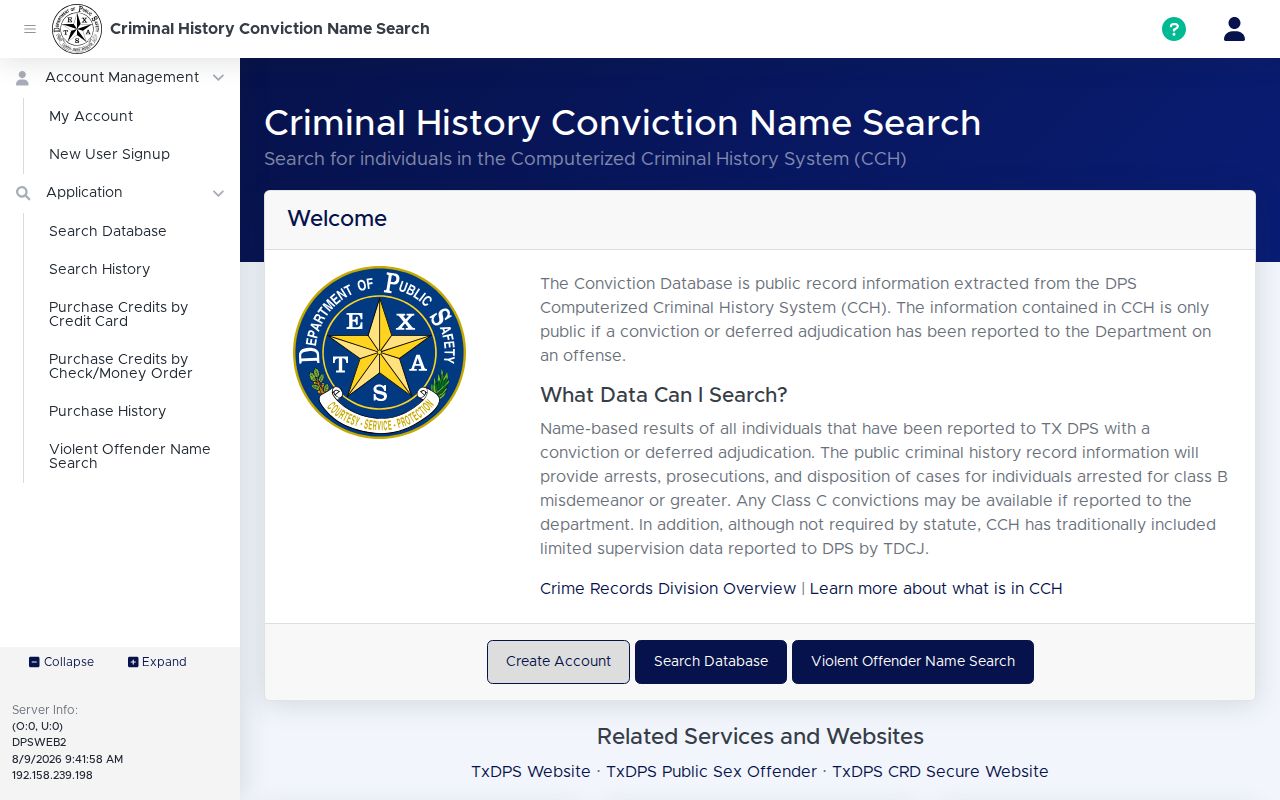
That state product should be read beside the court file, not as a replacement for the originating judgment.
Kinds of Criminal Records
Austin County criminal records reflect distinct steps. A sheriff, city officer, constable, or DPS trooper creates an incident or arrest report. Jail staff create a booking file. A prosecutor uses a complaint, information, or indictment to place charges before a court. District and County Clerks preserve dockets, orders, judgments, and costs. DPS assembles fingerprint-supported cycles for Class B and more serious offenses, subject to reporting and public-access limits.
Warrants remain tied to the issuing court and executing agency. County jail records cover local detention, TDCJ records cover state prison and parole locator data, and the multi-county CSCD holds community-supervision files. The Texas Public Sex Offender Registry is another distinct public system. Juvenile, sealed, expunged, victim, and private identifier information can be restricted.
- Arrest and booking records: show allegations, intake, bond, and custody events, not guilt.
- Criminal court files: show filed charges, hearings, motions, outcomes, and sentences.
- CCH entries: compile qualifying arrest cycles and reported dispositions at DPS.
- Warrants: are court orders whose current status requires direct verification.
- Supervision and registry records: have separate custodians and access rules.
Austin County Criminal Record Counters
The Austin County government directory separates two key locations in Bellville. The Justice Center at 265 N. Chesley holds the District Clerk in Suite 1, County Court at Law in Suite 3, Criminal District Attorney in Suite 5, and County Clerk in Suite 7. The Sheriff and jail are nearby at 417 N. Chesley. The historic courthouse at One East Main remains a civic landmark, but it is not the current criminal-clerk counter.
The official county home page provides the department navigation shown here.
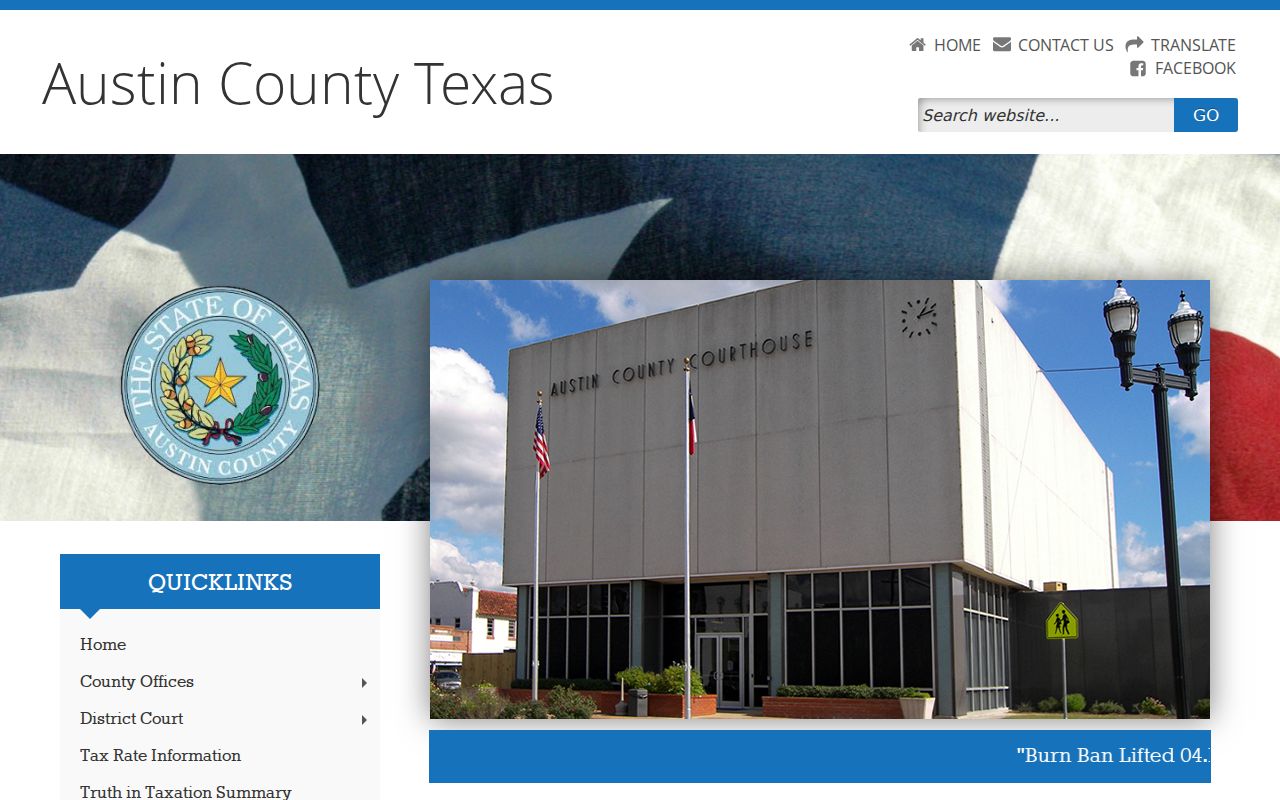
Use each office page for current hours before traveling, since the two clerk counters publish different schedules.
District Clerk
265 N. Chesley, Suite 1
Bellville, TX 77418
979-270-6830
County Clerk
265 N. Chesley, Suite 7
Bellville, TX 77418
979-227-3144
Sheriff and Jail
417 N. Chesley
Bellville, TX 77418
979-865-3112
Austin County Criminal Records: What They Contain
Fields depend on the custodian. A Texas CCH entry centers on identity and arrest cycles. A court file adds pleadings, counsel, hearings, financial entries, and orders. Booking records focus on intake, bond, and release. Read the source label first, then compare the charge with the disposition. Public systems suppress Social Security numbers and protected victim or juvenile data.
| Name & Identifiers | Names, aliases, birth details, descriptors, SID, or case identifiers where public. |
|---|---|
| Arrest / Booking Data | Agency, date, alleged offense, booking number, bond, and release status. |
| Charges & Statutes | Filed offense, Texas citation, level, and later amendments. |
| Disposition | Dismissal, plea, acquittal, conviction, no-bill, or deferred adjudication. |
| Sentence | Confinement, fine, costs, restitution, or community supervision. |
| Custody / Supervision Status | Jail release, TDCJ location, parole, or court-ordered supervision when public. |
Austin County Arrests vs Convictions
An arrest is an accusation and custody event. Filed charges can be reduced, changed, or declined. A grand jury may return a no-bill, a court may dismiss a count, or a factfinder may acquit. Even when a case ends without conviction, the police report and booking may remain unless a court grants relief. Use the final clerk disposition to learn the outcome and avoid drawing conclusions from the sheriff news page or an old booking reference.
- Disposition
- The recorded outcome of a filed charge.
- Deferred adjudication
- Supervision in which a finding of guilt is withheld, subject to Texas rules.
- No-bill
- A grand jury decision not to indict.
- Capias
- A court writ directing an arrest.
- Nondisclosure
- An order restricting public dissemination without erasing all government access.
Texas Public Access Laws
The Texas Public Information Act covers existing government records, subject to exceptions and cost rules. It does not require an Austin County office to answer questions, create a report, or retrieve another agency's file. Court records follow clerk custody, sealing, and redaction rules. DPS public dissemination is narrower than all criminal history held by the state. Requests work best when they name the incident, date range, agency, and exact record wanted.
Key Texas authorities:
Government Code Chapter 552 gives access to existing public records subject to exceptions.
Government Code Chapter 411 controls DPS dissemination and nondisclosure.
Code of Criminal Procedure Chapter 55A governs expunction.
Code of Criminal Procedure Chapter 62 governs sex-offender registration and public fields.
Austin County Warrant Verification
The Sheriff's warrant page did not expose a reliable public name field, list, update time, or disclaimer during research. Do not treat the page as proof that a warrant is active or cleared. Call sheriff dispatch at 979-865-3111 or the issuing court. Felony warrants connect to District Court, misdemeanor capias matters to County Court at Law, and fine-only warrants may remain with a municipal or justice court.
The official sparse warrant page is pictured below.
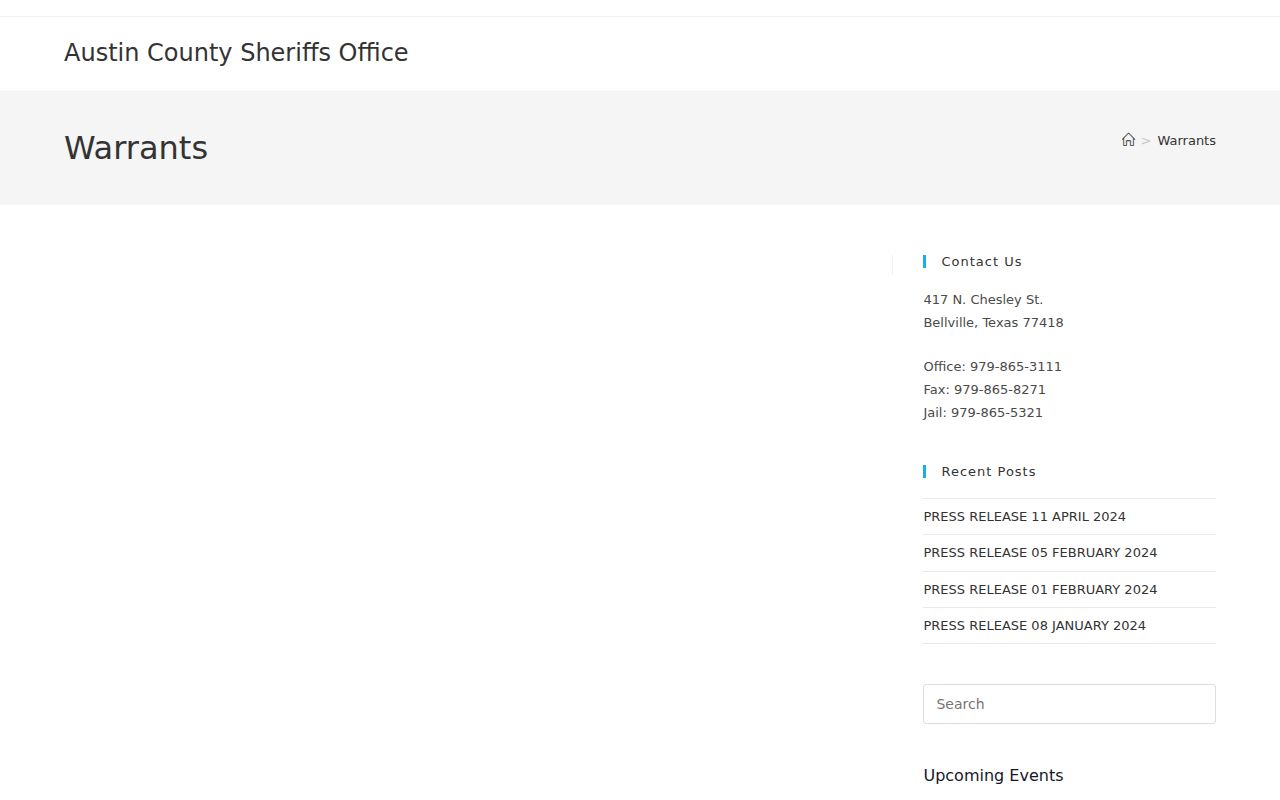
Someone resolving their own warrant should ask the issuing court for current instructions before appearing or paying.
Restricted, Sealed & Expunged Records
Texas expunction under Chapter 55A is the stronger remedy. It can remove or destroy records named in an order for qualifying acquittals, pardons, mistaken identity events, and some dismissals or no-bills. Eligibility is technical. A dismissal alone does not guarantee relief, and related charges can affect the result. Austin County petitions must go to the court with jurisdiction and should identify each agency that holds part of the record.
An order of nondisclosure restricts public dissemination but leaves access for criminal-justice agencies and other authorized users. It often concerns qualifying deferred adjudications or convictions and carries exclusions and waiting rules. First obtain a certified disposition from the proper clerk. After an order, keep certified copies and later check both county portals and a DPS personal review. Juvenile files, active-investigation details, victim data, and private identifiers have separate protections.
Austin County Jail Records Fallback
The Austin County Jail page publishes contact and visitation facts but no searchable public roster. Call 979-865-5321 for present custody. VINELink can add notifications. After charges are filed, search the right clerk. A written request may seek a booking sheet, though redactions and fees may apply. TDCJ search becomes relevant only after transfer to state prison.
The official sheriff listing confirms the county contact shown here.
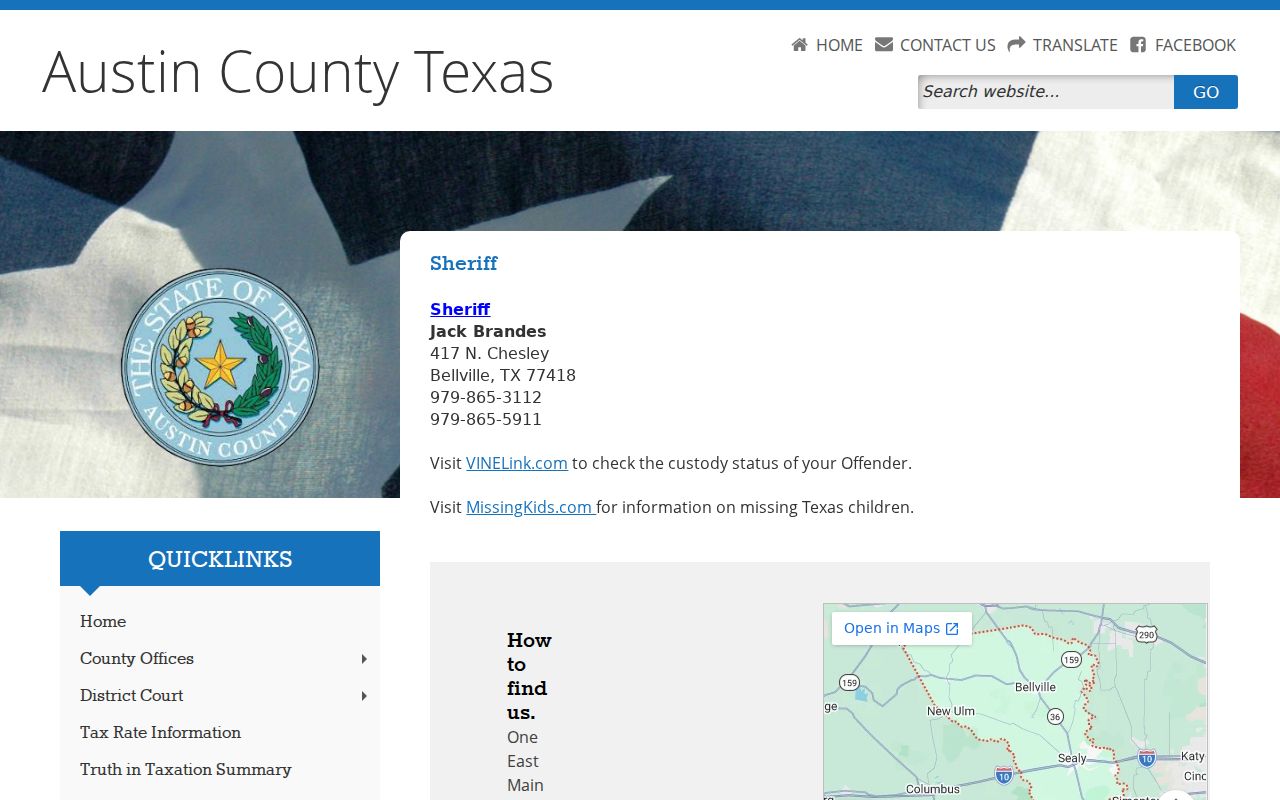
Custody location needs confirmation because female inmates have been temporarily housed in Fort Bend County and regional operations can produce cross-county bookings.
Visitation details also show why a direct call matters. For people housed in the Austin County facility, the published process requires a caller to contact the jail on Monday or Tuesday before a Friday or Sunday visit from 1 to 3 p.m. A visitor needs government photo identification, must appear on the inmate's list, and cannot have been held in that jail during the prior six months. One child may accompany one adult. The jail does not accept calls or messages for inmates. These rules describe visitation, not a way to prove custody, and they can change. Confirm them with staff before making plans.
Do not assume that a state inmate result will cover a recent Austin County booking. The TDCJ Online Inmate Search applies after a person enters state custody and supports name, TDCJ number, and SID number searches. It can show a state location, offenses, and a projected release date. County detention, temporary outside housing, probation, and a pending transfer require their own checks. This layered search takes more work, but it prevents a blank result in the wrong system from being mistaken for a current release.
Austin County Police Record Roles
Incident records stay with the agency that made them. Bellville Police uses its North Chesley lobby and city request form. Sealy Police offers an open-records service and has separate administrative and 24-hour dispatch lines. Wallis Police works through City Hall while Austin County dispatch answers calls. Sheriff records should be requested at 417 N. Chesley when deputies created the report or the jail created the booking.
The Sheriff's operational website supplies local service and news information.
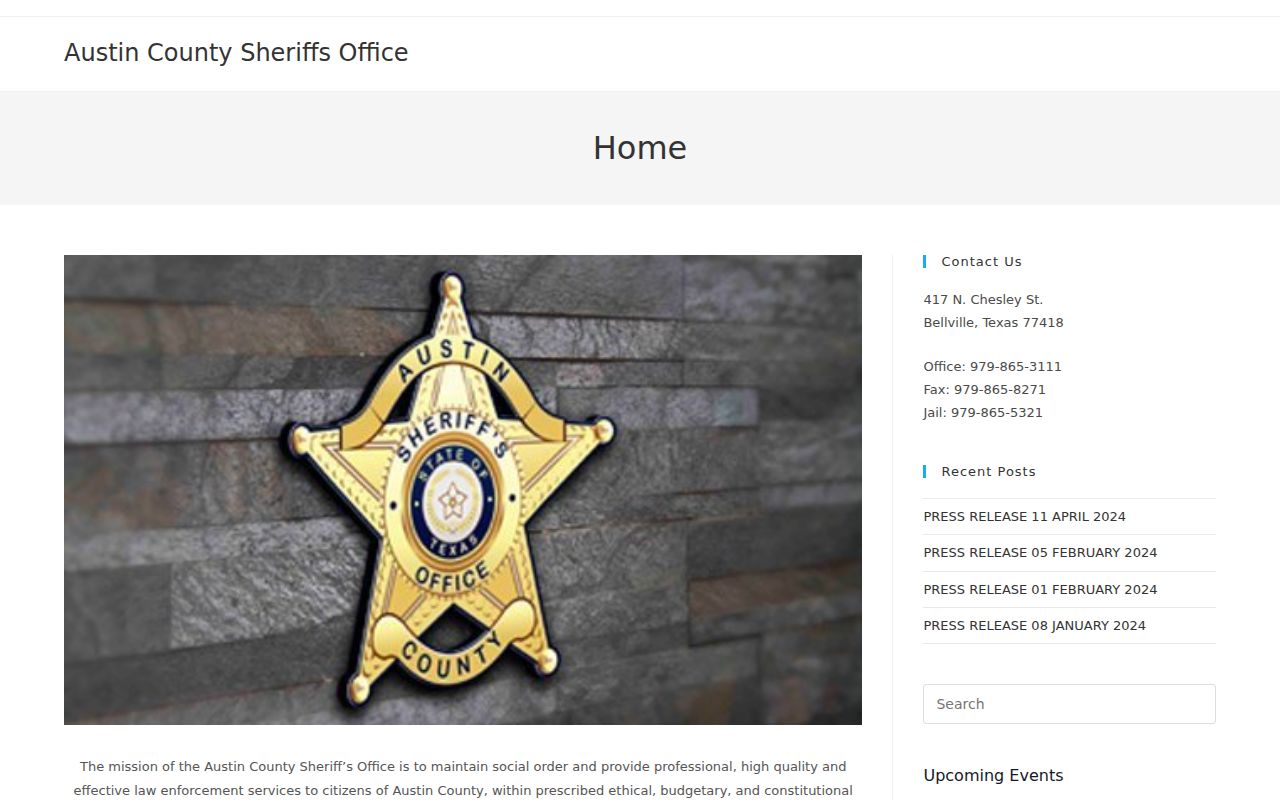
Selected sheriff news releases are not a complete arrest log, and no county police app or booking app was located.
Austin County Criminal Charge Records
The Criminal District Attorney files and prosecutes charges, but the office is not a neutral record custodian or full docket. Felonies proceed in the 155th District Court, Class A and B misdemeanors in County Court at Law, and fine-only matters in municipal or justice courts. This is why a district-only search can miss a Bellville, Sealy, Wallis, or JP citation.
The official District Attorney page identifies the prosecution office pictured here.
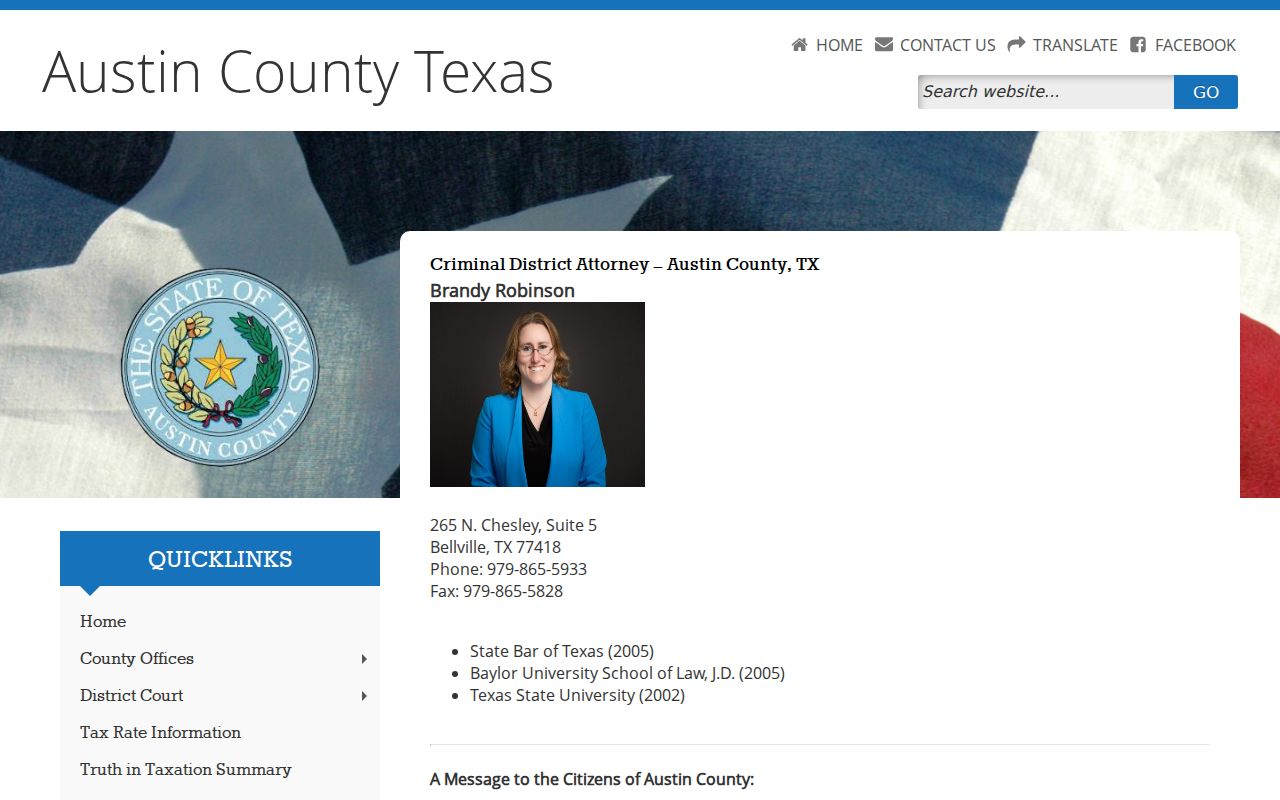
For a record, use the clerk. For a police narrative, use the agency. The prosecutor's selected press releases should not be treated as a case index.
City-by-City Criminal Records in Austin County
Sealy, Bellville, and Wallis police keep the reports their officers create, while each municipal court handles its city ordinance and fine-only cases. County clerks take over higher-level prosecutions, and the jail may hold people arrested by any of those departments. Start with the city guide when the police agency or municipal citation is known.
Sealy Record Check
6,839 in 2020 · Police records and municipal routing begin with city offices.
Bellville Record Check
4,206 in 2020 · City police, court, jail, and county clerks sit close but keep separate files.
Wallis Record Check
1,292 in 2020 · City Hall houses police and court contacts, with county dispatch support.